LYME
LYME is a fully custom free-space optical (FSO) link that sends a real-time analog video signal across open air on a laser beam. Rather than transmitting digital bits, the laser's brightness is amplitude-modulated to follow a standard Composite Video (CVBS) waveform — proving that a single transistor on the transmit side and one op-amp on the receive side can carry the ~5 MHz of bandwidth live video demands.
- ROLE
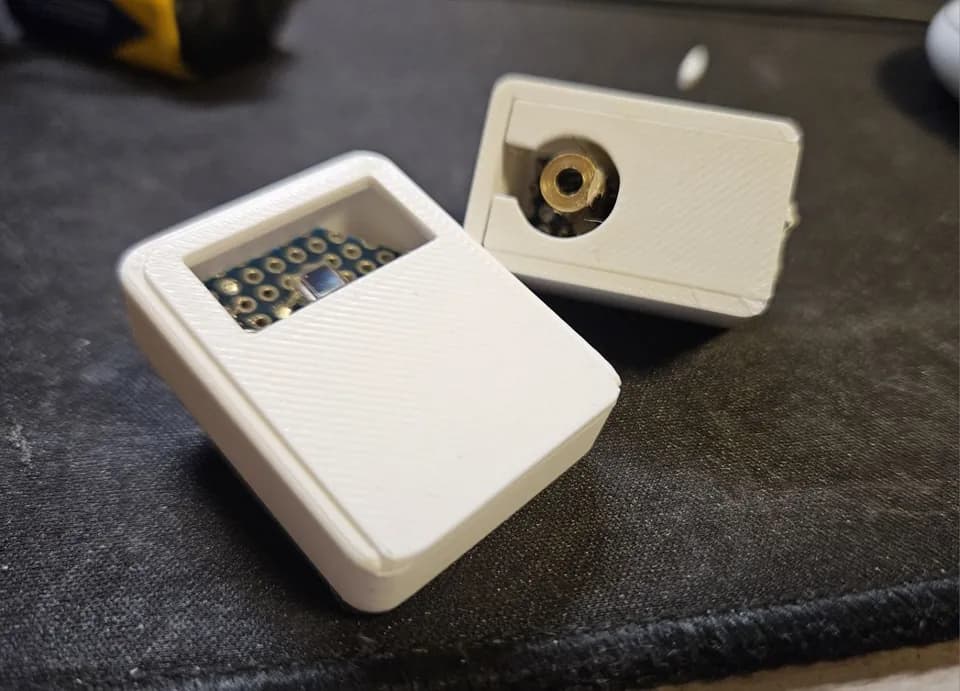
- Analog design, PCB, simulation, enclosure
- ANALOG BANDWIDTH
- ~5 MHz CVBS 50/60 FPS over air
- STACK
- KiCad · Fusion360
Free-space optical link carrying live analog video across open air on a modulated laser beam.
Digital transmission over a DIY optical link collapses under the arithmetic: at an optimistic 1 Mbps a 640x480 grayscale frame takes over two seconds, and encoding stills as audio tones costs 8-120 s per image. Both destroy any notion of real time. LYME sidesteps the bandwidth wall by returning to analog — one CVBS waveform carrying sync, luma and chroma at once, at 50/60 FPS.
Key features
- 01
Analog CVBS over a laser beam — amplitude modulation instead of digital bits, carrying sync, luma and chroma at once
- 02
Transmitter superimposes the AC video onto a DC bias and drives the laser through an emitter follower, so the beam's brightness tracks the waveform
- 03
Adjustable bias holds the laser at its optimal operating point — the calibration that decides whether the picture locks at all
- 04
Receiver pairs a reverse-biased PIN photodiode with a high-speed transimpedance amplifier on a dual rail, turning photocurrent back into video voltage
- 05
Feedback compensation sized from the photodiode's own junction capacitance kills the amplifier's high-frequency ringing
- 06
A series terminator at the output absorbs cable reflections, removing the horizontal smearing a cheap USB capture card introduced
- 07
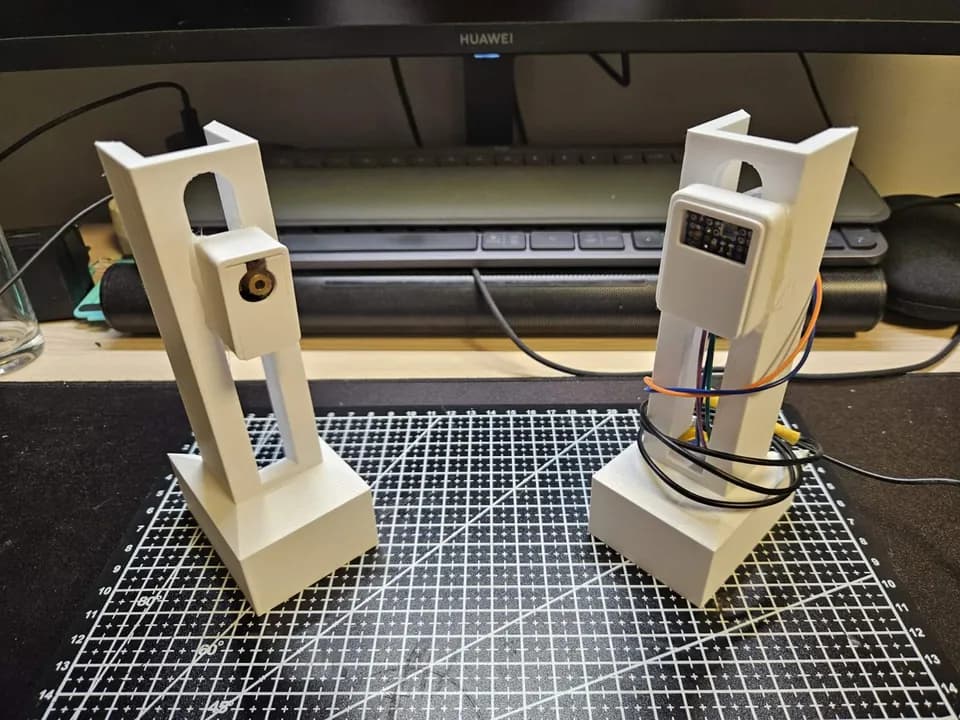
Both stages validated in LTspice before anything was built; KiCad schematics and 3D-printed TX/RX housings in the repo